
Deciding on the right online learning platform isn’t purely about price or number of courses. It really comes down to what you want, how you learn, what your goal is (degree, credential, personal growth) and what constraints you have (time, budget, credit‐acceptance).
In this comparison I’ll walk through two distinct platforms — Saylor Academy and Sophia Learning — side by side: what they are, how they differ, what users say, and how you can decide which fits you best.
What Is Saylor Academy?
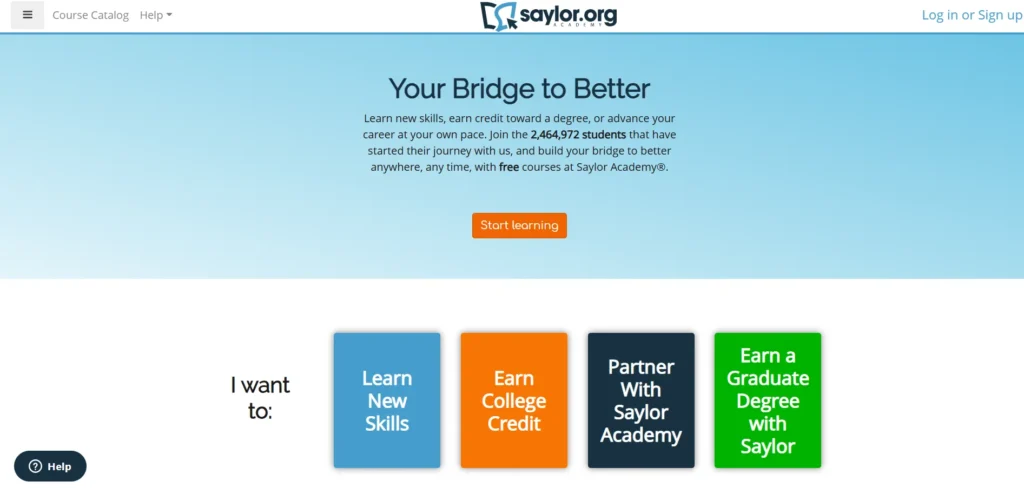
Saylor Academy is a non-profit initiative based in Washington D.C., founded by Michael J. Saylor. It offers free or extremely low‐cost online courses built largely on open educational resources (OER). According to their mission, they aim to offer full-length college and professional level courses, accessible to anyone, anywhere, on a self-paced schedule.
In practical terms: you can pick a course, dive into readings/videos, complete assessments, move at your own speed, finish when you’re ready, often at no cost (or minimal cost if you want credit). Because it is non-profit and uses open resources, it appeals especially to learners who want access, flexibility and affordability rather than full traditional college structure.
But it’s also important to note what it isn’t: Saylor is not an accredited degree-granting university by itself. So if your goal is a formal degree or guaranteed credit transfer, there are extra checks you’ll want to do.
Key Features of Saylor Academy
Here are the important aspects of what Saylor offers:
- Free access to courses: The majority of their courses can be enrolled in and completed at no cost. That means the barrier to entry is low.
- Self-paced learning: You decide when to study, how fast. There are typically no fixed times, no live lectures you must attend.
- Open Educational Resources (OER): Since the materials are often openly licensed, Saylor can keep costs minimal and make materials widely available.
- Wide subject breadth: Saylor’s catalog spans a broad array of disciplines—business, computer science, humanities, social sciences, mathematics, etc.
- College credit recommendation options (in some cases): Some Saylor courses carry “credit recommendation” status via third‐party bodies, meaning some colleges may accept them for credit. But this is not universal and depends on the receiving institution.
- Low cost or minimal cost barrier: Because most of the content is free, you can experiment, learn for enrichment, or build knowledge with little financial risk.
What Is Sophia Learning?
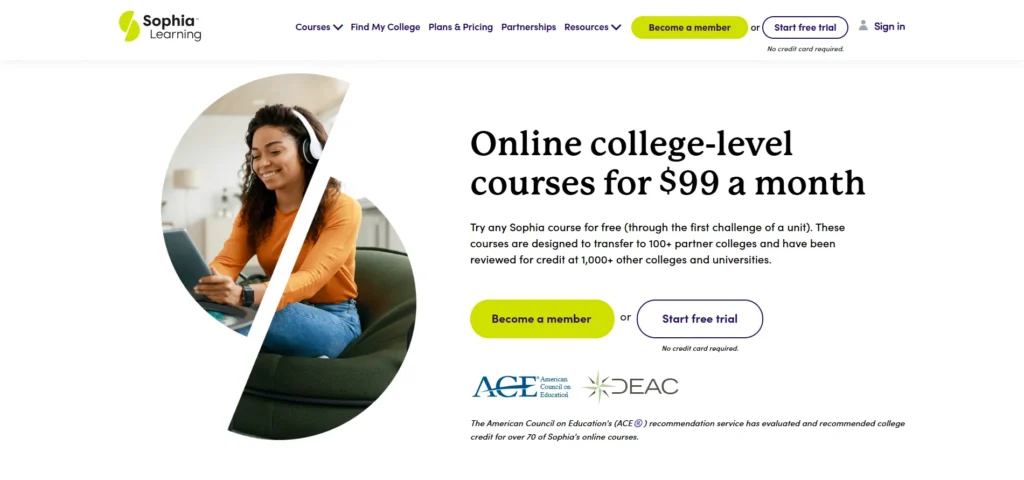
Sophia Learning (often called simply Sophia) is an online platform that focuses on college-level, general education or foundational undergraduate courses, framed especially for learners who may want transfer credit, degree acceleration, or an efficient route through general education requirements. They use a membership model rather than always charging course by course, they emphasize flexibility and pace, and their messaging targets students looking to save time and money in higher education.
In other words: if your goal is to knock out general education or foundational courses, get credit, move through quickly, and you’re comfortable with a self‐paced environment, Sophia may appeal.
That said, like all things, there are conditions: the membership model means you pay for access over time rather than simply “one course for one fee.” Also, transfer credit is never absolutely guaranteed. So it’s still smart to check your institution.
Key Features of Sophia Learning
Some of the features you’ll find:
- Self-paced, on-demand courses: You start when you like, work when you like. They emphasize “learn anytime, anywhere.”
- Membership pricing model: Rather than paying per course in all cases, you pay for a period of access (monthly or multi-monthly) and can take courses during that period (often with a cap like two courses at a time).
- Credit-transfer focus: Many of their courses are evaluated for credit by credible bodies (such as the American Council on Education) and the platform highlights that students have sent transcripts to many colleges/universities.
- General education / foundational undergraduate focus: The course catalog emphasizes subjects that many university programs require in the first one or two years: English composition, history, science, mathematics, etc.
- Flexibility and speed: For those who can dedicate focus, you can progress quickly through courses and potentially reduce time/cost in your overall degree path.
Quick Comparison Table
Here’s a straightforward table summarizing major dimensions of difference:
| Feature | Saylor Academy | Sophia Learning |
|---|---|---|
| Cost | Mostly free access to the course materials | Paid membership model (access many courses for a period) |
| Learning pace & flexibility | Fully self-paced, unlimited time | Self-paced but membership time means you may want to be faster |
| Credit transfer potential | Some courses have credit recommendation status | More courses built specifically for transfer credit |
| Breadth of subjects | Very broad (many disciplines) | More focused on general education / foundational courses |
| Platform & usability | Simple, minimalistic platform; heavy reading | More modern interface, unit/challenge/milestone structure |
| Ideal learner profile | Budget-sensitive, self-motivated, exploratory | Degree/credit-seeking, willing to invest, ready to move fast |
Course Offerings and Content
Saylor Academy Courses
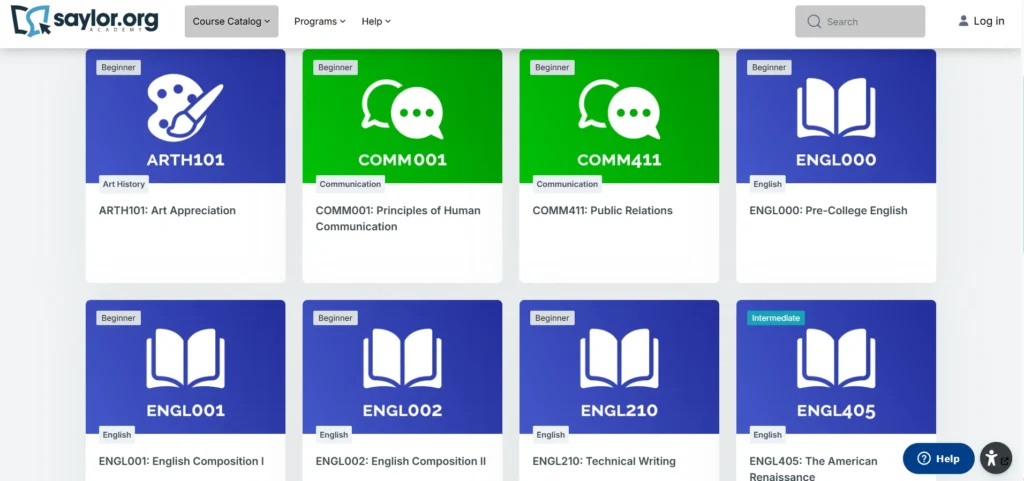
Saylor publishes a catalog with over 100 courses (some sources list 113 courses). For example, their site/front lists “150+ full-length courses at the college and professional levels”. Many of these courses are estimated at “10+ hours” in duration, with variations depending on how deeply you engage.
From reviews: One listing shows that 93 of the 113 courses are “10+ hours” in estimated time. Saylor’s catalog includes business (28 courses), humanities (24), social sciences (15), personal development (13), computer science (9), mathematics (9), programming (6) and science (5). So you get a wide spread.
What do users say? On forums one user wrote:
“They provide way too much unnecessary information for accelerating. Though it’s less money, it will take more time and effort to complete.”
(about Saylor)
Another posted:
“Saylor can be hit and miss. Their problem is they don’t develop or host any of the course content. So some courses are disjointed, with redundant material, uneven use of terminology, and broken links.”
So what emerges: Saylor’s content is broad and can be deep, but quality and polish vary. If you enroll in a course, you might get a course with clean structure and decent flow; or you may find broken links, sections that feel outdated, heavy reading, and minimal hand holding.
If your learning style is independent, comfortable with reading and self-study, and you’re not overly concerned about perfect structure, Saylor gives you a lot of value, especially for free. But if you prefer more guided format, multimedia-rich, frequent interaction, you may find it somewhat raw.
Sophia Learning Courses
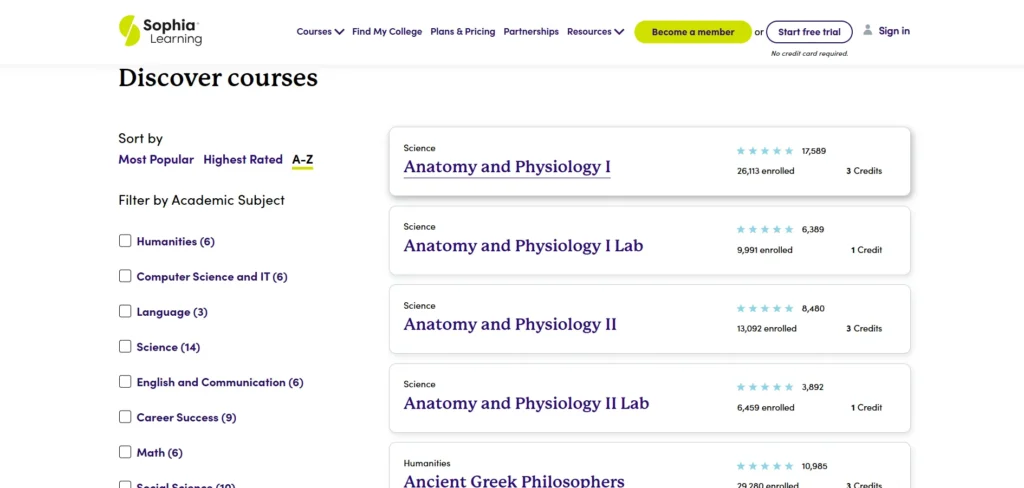
Sophia’s catalog is more targeted — they highlight “70+ online college‐level courses” (or more depending on updates) that are built with transfer credit in mind. One article by them says: “Sophia offers a range of self-paced, college‐level general education courses that may transfer to other institutions.”
Another user review said:
“The best way to describe Sophia courses is a more modern, digital cliff notes version of a college course. You learn the same amount of information but in less time which is how learning should be…”
On the flip side, some users have criticised parts of the platform. For instance:
“The class contents vary greatly in quality depending on different subjects; … the practice questions and milestone questions have nothing in common and can often be worded very ambiguously.”
So the pattern: Sophia courses lean toward efficiency and structure. You’ll often find units built around “Challenges”, “Milestones” and “Touchstones” (essays/assignments) which helps guide pace and progress. But again, there’s variation across courses; some may feel highly structured and effective, while others might feel less polished or harder to follow.
From one forum: someone reported completing six Sophia courses in one week — which suggests that, for motivated learners who are already comfortable with the material, Sophia can allow very fast progress. Others remarked that milestone questions or assignments in certain courses felt unclear or poorly aligned.
Accreditation and College Credit Transfer
Saylor Academy Accreditation
Important to emphasise: Saylor Academy itself is not an accredited degree‐granting institution. They offer courses and certificates of completion, some of which have “credit recommendation” status through third parties (like the American Council on Education or NCCRS). That means the course has been evaluated and may be eligible for credit by a college under certain circumstances.
From their site: Saylor lists partner institutions who recognize or accept their courses for credit transfer. But the big caveat is: each receiving institution sets its policy. Just because Saylor says a course is “credit‐recommended” does not guarantee that your institution will accept it for your specific degree program. Thus if your goal is formal college credit, you need to: check with your college, check the subject‐match, check deadlines, check exam/proctoring conditions, check any fees that apply for credit‐exam or transcript issuance.
From a user forum:
“Saylor courses and exams aren’t really that great or bad, they’re similar to TECEPS as you really need to know the material because it’s all on that one exam to get a pass. If you know the material, it won’t be an issue …”
Another:
“I have not taken a course at Saylor … If it fits your plan then you can take the Saylor course … I would take them for credit for courses not offered elsewhere for alternative credit.”
So with Saylor: good if you’re prepared and proactive — but you assume more responsibility for ensuring the credit path works.
Sophia Learning Accreditation
Sophia positions itself more squarely toward transfer credit: their website states that “The American Council on Education’s recommendation service has evaluated and recommended college credit for over 70 of Sophia’s online courses.” They also claim students have sent transcripts to 1,000+ colleges/universities. They show “partner colleges” in their directory.
However – and this is critical – credit transfer is never automatic or guaranteed. Each college/university still sets its own policy, evaluates the course, may require additional accreditation, or may limit transfer credits from non-traditional providers.
From a consumer complaint: one user said the platform sanctioned their account for “multiple logins” and they were unable to get transcripts or credit, despite completing coursework. That indicates that platform policies (integrity, login/devices, etc) can impact your course completion and credit path.
Thus with Sophia: stronger infrastructure for credit transfer compared to a purely free platform, but you still must verify with your institution, check lock-in terms, check membership timelines, check support/policies.
Cost and Accessibility
Saylor Academy Cost
One of the standout advantages of Saylor is its cost‐profile: most of the courses are free to access and complete. You can study for enrichment, skill development, even certificate of completion, without paying tuition. From user reviews:
“It’s FREE (actually $5) college credit! What more could you ask for!?”
Another user review on Trustpilot rated the site “3.2 out of 5” with 11 reviews; one user said “The site constantly crashes … The usability is quite lacking.” So cost is minimal, but support and platform robustness may be lower than paid services.
Because the cost barrier is low, accessibility is high — learners from anywhere, including India or other international locations, can enroll and study on their schedule. That makes Saylor appealing for self-motivated learners globally.
However: minimal cost also means minimal built‐in support or features, and the trade-off is often more self‐management, fewer hand-holds, possibly out‐of‐date materials or structure.
If you’re in India or another country, you’ll also want to check whether the internet connectivity, time zones, and device compatibility work well for you. With a free service, you bear more of the burden of making it work.
Sophia Learning Cost
Sophia uses a membership model: you pay for access to the platform for a defined period (often monthly), and during that period you can take courses (with a cap on concurrent courses — e.g., up to two at a time).
Their website says “Unlimited access for $99 a month” (for example) and you can “take as many courses as you want during your membership period”. They also mention “No course registration fees or additional fees for materials; everything is included in your membership.” So in one sense the cost is predictable: you pay per time period rather than per course.
What this means: if you’re motivated and can move quickly, you might complete multiple courses in one membership period and derive high value (e.g., finish 3‐4 courses in one month). But if you move slowly, you might end up paying for several months and finishing fewer courses — which reduces value.
From a complaint: a user said they finished one course, tried to begin another, but were not permitted until some time later — thus reducing their “value” of the membership. Another user noted that when their account was sanctioned by Sophia (due to alleged policy violation) they lost time and were unable to get extension or refund.
For a learner in India, you should consider: membership fee converted to Indian Rupees (and any taxes). Also, the “two courses at a time” cap means you might want to plan your schedule to make efficiency count. Also check whether content, device compatibility, browser issues, time zone support (for any assessments) work well for you.
In summary: Sophia’s cost is higher than Saylor (because you pay membership) but it offers different value (transfer credit, faster progression, more structure). Whether the cost is worth it depends on your pace and goal.
Support and Learning Environment
Saylor Academy Support
Because Saylor is largely free and self‐paced, the support environment is leaner. You’ll often find the following characteristics:
- Course materials (readings, videos, assessments) are provided.
- Some practice exams and final exams exist.
- The platform invites peer reviewers (subject matter experts) to review course content for quality (they pay honoraria to reviewers). This suggests some emphasis on quality.
- But user reports indicate: broken links, inconsistent formatting, older interface, occasional downtime or crashes. Example from Trustpilot: “The site constantly crashes … the site looks like it was made in the 1990s.”
- There is minimal live instructor support, minimal scheduled classes or cohort structure. There may be user forums but likely less vibrant than paid services.
Therefore if you choose Saylor, you should be comfortable working independently, troubleshooting issues, organizing your own schedule, motivating yourself, and dealing with occasional platform limitations.
Sophia Learning Support
Sophia’s structure is more robust in terms of interface and progression: they use units of “Challenges” (quizzes), “Milestones” (assignments) and “Touchstones” (essays/projects) as described in their blog post. This gives the learner a clear progression. There is a free trial available, membership options, and flexibility in starting/ending.
In terms of support: there are mixed reviews. Positive: some learners find the interface smooth, the units well structured, progress quick. Negative: some learners have reported issue with honor code sanctions, device/login limitations, membership restrictions, difficulty in getting help when something goes wrong. For example: a complaint noted that multiple device logins triggered sanctions, despite no policy that devices should be limited. Another noted delays in ID verification/assignment submission, and inability to get extension of membership time after technical issues.
Therefore with Sophia: you’ll get more structure and perhaps a more refined platform experience compared to a purely free platform, but you still need to check the terms closely (device, login, timed access, membership renewal, assignment expectations) and be active in managing your membership and progress.
Pros & Cons
Saylor Academy
Pros:
- Very low cost (often free) – excellent if budget is a major constraint.
- Wide range of subject options – you can explore many fields without heavy investment.
- Fully self-paced – fit studies around your life.
- Accessible globally – ideal for learners in India or elsewhere with fewer resources.
- Good option for lifelong learning, skills development, enrichment, or early exploration without risk.
Cons:
- Course quality varies – some courses are excellent, others are less refined (broken links, outdated resources, uneven formatting).
- Platform usability/support may be minimal – you must be comfortable with independent study and occasional technical hiccups.
- Credit transfer is possible but not guaranteed – you’ll need to verify with your institution, and sometimes the exam or support structure is less robust.
- Little or no live instructor or cohort environment – if you prefer interaction, you may miss it.
- Because the model is free, you might not get as many motivating features or high-engagement media as paid platforms.
Sophia Learning
Pros:
- Purpose built for credit/transfer and degree acceleration – offers an appealing value if you’re aiming for formal academic credit.
- Structured course format with clear units – helps learners who prefer guided progression.
- Membership model encourages speed and efficiency – good if you have time and focus.
- More polished platform – likely better user interface, progress tracking, assignments etc.
- Flexibility: self-paced, start anytime, fit around your schedule.
Cons:
- Monthly membership cost – you pay for time, so slower pace means higher effective cost.
- Quality variation – not all courses are equal; some users report ambiguous assignments or inconsistent support.
- Membership terms/device/login/honor-code policies may introduce friction – especially for international or mobile learners.
- Credit transfer is still not automatic – you must check your institution and course suitability.
- The model may pressure learners to move faster than they’re comfortable with, which could lead to burnout or incomplete courses.
Which Platform Is Right for You?
The key to picking between Saylor Academy and Sophia Learning is to match the platform to your goal, style, pace, budget and situation. Here are some scenarios to help you decide:
- If your budget is extremely tight and you simply want to learn and gain knowledge, course certificates, or build specific skills with minimal cost: go with Saylor. Because the cost is low (often zero) you have low risk. This is especially true if you are comfortable self-motivation, independent study, and you are in a country (like India) where cost is a major factor.
- If you are enrolled in or planning to enroll in a college/university, and you want to reduce time or cost by taking general education courses online and transferring credit: then Sophia Learning may be more appealing. The platform is built for that scenario. If you can move quickly and are comfortable with membership cost, you could potentially very efficiently knock out several courses in less time.
- If you prefer a slower pace, like one course at a time spread over weeks/months, with no rush, then Saylor’s free model is forgiving. With Sophia you’ll want to ensure you’re comfortable managing pace because the membership cost can make slow progression less efficient.
- If you prefer more guided structure, assignments, clear tracking, perhaps some semblance of deadlines or unit milestones: Sophia might suit you better. If you prefer minimal structure and own your schedule fully, Saylor could work fine.
- If you are living outside the US, for example in India, you’ll want to check: what time zone issues (if any), what device compatibility, what internet connectivity needed, how seams/assessments work. For a free platform like Saylor, you may accept occasional hiccups. For Sophia you may want to check membership cost in INR, device and login policies, and how the platform deals with mobility/IP changes (so you don’t accidentally trigger sanctions).
- If your primary goal is enrichment or personal growth (rather than formal degree credit): Saylor is likely a strong fit. You can explore multiple topics, build knowledge, maybe obtain certificates, without heavy cost.
- If your primary goal is to get credit and accelerate a degree: Sophia likely offers better alignment—but only if you check the details and commit to the pace.
One more thing: you could use both platforms in tandem. For example: use Saylor for skills building or exploratory courses where credit isn’t critical; and use Sophia for the “must transfer” general education courses. That way you maximise flexibility and minimise cost.
Conclusion
In the end, there is no one “best platform” for everyone—just the platform that best fits you. Here’s a summary:
Saylor Academy is a stellar choice if affordability, flexibility, and self-paced learning are your most important criteria. It gives you access to a broad catalog of courses at minimal cost, with full freedom to go at your rhythm. The trade‐offs: variable quality and less structural support; credit transfer is possible but not guaranteed.
Sophia Learning is a strong choice if you are degree-minded, want credit transfer, want structured pacing but still self-paced, and are willing to invest in membership. You’ll likely get more platform polish and faster progression—but you’ll also pay, and you’ll want to move with some speed and check your institution’s policies.
If I were to give a short recommendation: if cost is your main concern and your goal is learning (not necessarily formal credit), go with Saylor. If your goal is formal academic credit, faster progression, and you’re ready to invest time & money, go with Sophia—but verify the details.
As someone based in India (or anywhere where global access matters), you might favour Saylor for its free access and minimal risk. Then if you decide to pursue formal credit or an international-recognised degree, evaluate Sophia (or similar platforms) and check how your institution accepts the credits.
If you like, I can dig up current course examples from both platforms (with sample hours, international pricing, user ratings) and compare two‐three parallel courses side by side (for example “Intro to Business” on Saylor vs “Intro to Business” on Sophia) so you can see how content, cost, pace and acceptance stack up. Would that be helpful?
FAQs
Are courses on Saylor Academy really free?
Yes — most courses are free to enrol and complete, though there may be small fees if you pursue proctored exams or for formal credit.
Does Sophia Learning guarantee my credits will transfer to my college?
No — even though many courses are evaluated for credit, each college/university sets its own transfer policy. Please check with your school.
Can I move very fast through Sophia Learning courses?
Yes — the platform is self-paced and depends on your effort; some learners report finishing multiple courses in very short time frames.
Does Saylor provide live instructor sessions or weekly classes?
Generally no — Saylor is self-paced, largely reading + assessments; you will seldom have live classes, which means you need to be self‐motivated and organised.
Which platform is better for someone in India?
If cost is the main constraint, Saylor is likely a better fit because of its free access. If you are seeking credit and are comfortable with membership cost, Sophia could be worthwhile—but check local compatibility (internet/dates/devices) and your institution’s credit acceptance.